Showing posts with label Greenland. Show all posts

Friday, October 14, 2011

Parting Thoughts

As the days before my departure for Kangerlussuaq have slipped away, I've undergone a curious transformation. The prickly feelings of nervous anticipation that have been building over the past 50 weeks have floated off like dark clouds on a spring morning, replaced by a cold and enveloping sensation of terror.

Not having visited Greenland before and having accumulated precisely zero cold weather running experience has hardly kept me from forming a number of cock-sure beliefs about the environment, the course and my performance.


For example:

  • Although the temperature on race day is likely to be around 15-degrees Fahrenheit, the air in Greenland is exceedingly dry and there is very little wind, so it actually feels much warmer. Really.
  • The race has a net dissent of 1600 feet, with the last 20 miles, a smooth downhill amble, making for easy running. The first 2.5 miles, however, are a rapid climb up a sheer ice face.
  • Reviewing 10 years of past results reveals not a single DNF! "If everyone finishes," he chuckles, "how tough can it be?" Or, perhaps, the names of those who fall into crevasses, get trampled by muskoxen, or succumb to hyperthermia are expunged permanently from the records.


A Travel Note...


My Polar Adventure is hitting the road. On Tuesday, I fly to Copenhagen, arriving Wednesday afternoon. The following morning, I and 99 other madcap marathoners will board a plane for Kangerlussuaq. (If you refer to a map, you'll note that my travel route is a bit like flying from Los Angeles to Toronto by way of Krakow.)

I expect to tour the Russell Glacier on Thursday and review the race course with my new mates on Friday. The real test of nerves and frozen family jewels begins bright and bitingly early on Saturday.

If technology serves me well (a 3% likelihood), I'll be blogging here and posting photos to Facebook and Picasa at annoyingly frequent intervals.


I look forward to seeing you all in sunny Southern California soon.

Friday, October 7, 2011

Why?

I was not athletic as a child. In gym class, when it was time to pick teams for softball, kids with broken arms were selected before me. At the beach, 99-pound weaklings kicked sand in my face. I was constantly teased for being soft, slow and sissified...by my mother.


That pretty much held true for me up to middle age. Then one day, when I was 45-years-old, I ran across Robertson Boulevard (to buy a bagel) and immediately doubled over wheezing and out of breath. I felt I had to do something. So that same day, I joined a gym. I mounted a treadmill, flipped it on and promptly fell off.


Ten years later, I heard a 2-minute story on NPR about a marathon on the ice cap in Greenland. The reporter described it as an insanely frigid event attended by the most hard-bitten, devil-may-care athletes. The news hit me like a bolt of lightning because, having by then completed nearly 40 races of marathon distance or longer, I knew it was something I could do. In fact, if I could have teleported to Kangerlussuaq, I was pretty confident I could have run the course that day. It was a very empowering revelation. So much so, that had Arnold Schwarzenegger, Jesse Ventura and Hulk Hogan happened along at that moment, I would have kicked sand in their faces.


Now, it would be shallow and immature if I were travelling all the way to Greenland simply to exorcise a demon from the eighth grade. The truth is, I've put all that behind me and have learned to embrace running as an opportunity to stay fit, commune with nature and enjoy the company of my friends. In fact, if I could have one wish it would be to have some of my old pals from junior high school there with me in Greenland so that we could together experience the magic and excitement of striding up to the start line of an incredible race...right before I kick their butts.

Saturday, October 1, 2011

Collapse

Jared Diamond in his excellent book Collapse describes the quixotic attempt of Norse to colonize Greenland around the turn of the first millennium. The island was given its counterintuitive name by Erik the Red, a vicious marauder, imaginative p.r. man and ancient patriarch to yours truly. Erik used the image of a verdant Shangri-La to lure his gullible fellow countrymen across the North Atlantic in creaky wooden ships. What they found was hardscrabble land, biting cold and nary a green shoot or twig in sight.


Remarkably, they made a go of it for more than 400 years. But their tiny communities never really thrived and, eventually, they died out. (Legend claims they hightailed it to Tahiti.)  As Diamond explains, farming was tough and resupply from Scandinavia erratic. Most crucially, the Norse failed to acquire a taste for the one food source in abundant supply: fish.


In just a few weeks, I'll be retracing the journey of the ill-fated Norse colonizers to take part in the Polar Circle Marathon-only I'll be doing so in considerably more comfort. I'll travel to Greenland by plane, stay in a modern hotel and dine in a pleasant restaurant with an agreeable menu and passable wine list. I will be braving the cold for the 4 1/2 hours or so that it will take to run the marathon, but I'll be driven to the start in a mammoth ATV, snugly attired in Gortex, and plied with hearty soups and hot beverages every few miles by race staff.


This will provide me with a once-in-a-lifetime opportunity to witness the magnificence of the Arctic. And I'm lucky to be visiting now as Greenland's vast ice sheet and towering glaciers are slowly melting...due to the fossil fuel consuming lifestyles of people like me who travel in planes, ride in motor vehicles, reside in temperature-controlled buildings and eat two servings of beef per day.


Erik the Red would be amused.

Saturday, September 17, 2011

A Road to Nowhere

However you slice it, Kangerlussuaq, Greenland, site of the Polar Circle Marathon, is remote. Located at the end of a long, narrow fjord near the island's southwest coast, the town is more than 100 miles from Sisimiut, its nearest neighbor, and there are no roads connecting the two. Getting out of town by boat means a long and treacherous sea journey. Stir crazy residents could fly out, as the town boasts an international airport, but flights to Nuuk, the capital, and other local towns, or to Copenhagen are infrequent, and there is no Southwest Airlines offering wanna-get-away fares. If by some quirk you find yourself marooned in Kangerlussuaq for an extended period, I suggest you subscribe to the deluxe package from the local satellite TV provider.


Originally, Kangerlussuaq was an American Air Force base called Bluie West Eight. It was built in World War II under the supervision of Bernt Balchen, a pioneering Norwegian aviator who served as an American colonel during the war. The base later became a northerly outpost in the Cold War. (One can imagine U.S. servicemen stationed there in the '70s begging for transfers to Viet Nam.) After the Berlin Wall fell, the base's importance declined and the U.S. government gave it to the Greenlanders in 1992.

That was nearly the kiss of death for Kangerlussuaqers. Without well paying American jobs, the population dropped below 300. It became hard to find canasta partners on Saturday night. However, two things happened that sparked a revival in the town's fortunes. First, reindeer and muskoxen were reintroduced to the area and that led to a mini-boom in tourism and hunting.
Secondly, Volkswagen took an interest in the place. The German automaker wanted to build a test track to evaluate cars under extreme conditions and Kangerlussuaq, with its flat-as-a-pancake topography, windless environment and dependably cold temperatures, fit the bill. In 2000, a 19-mile gravel road was built. It proved to be a better idea in theory than in practice. German engineers found that they preferred conducting cold weather computer simulations from the comfort of Bavaria. So, after just a few years, Volkswagen pulled out.

But the road was there. And it just happened to lead to the base of the Greenland Ice Sheet, making Kangerlussuaq the only place in the entire northern hemisphere where it is possible to visit an ice sheet without traveling by helicopter. That transformed Kangerlussuaq into a Mecca for Arctic tourists. (Okay, "Mecca" may be too strong a word.) In addition, a few enterprising locals determined that by adding a short scamper across the ice sheet itself, the road could be formed into a 26.2 mile course for mentally unstable runners. In 2001, 130 frigid athletes with unpronounceable Scandinavian names ran the first Polar Circle Marathon.

Saturday, September 10, 2011

A Big, Empty, Frozen Place.

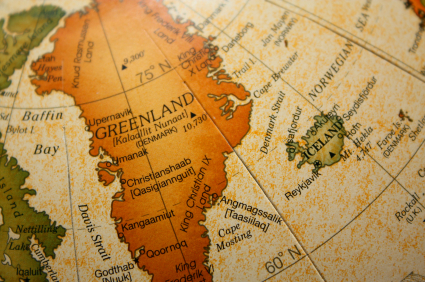
Greenland is the largest island on earth. (Sorry Australia, you’re a continent.) It covers some 836,000 square miles, nearly twice the size of California and Texas combined, and yet is home to a mere 57,000 souls, making it the world’s least densely populated country. Nearly all of the people live on the island’s southern fringe, or one of several smaller islands that dot its coast. That is because the majority of the landmass—more than 80 percent—is covered by an ice sheet, an inhospitable place to pitch a tent, even if your tent is an igloo.

Although tacitly self-governed, Greenland remains part of the Kingdom of Denmark. After World War II, the U.S. government offered to buy the place for a cool $100 million, but the Danes turned them down flat. Considering they are now subsidizing Greenlanders to the tune of more than a half billion dollars per year, the Danes must be kicking themselves over that.
Nuuk, the capital, population 15,000, is a charming urban encampment of wood frame houses and Lutheran churches. Situated on a fjord in the southeast of the country, it has a number of modern conveniences rare in other parts of Greenland, including roads, running water and a Starbucks franchise. (Okay, I’m kidding about Starbucks.) By contrast, Kangerlussuaq, where I’ll be running the Polar Circle Marathon, is home to only 500 year-round residents. It, no doubt, is looked upon as a bumpkin backwater by cosmopolitan Nuukers.

Greenland’s ice sheet is a marvel of nature; second only in size to the one at Antarctica. At its thickest point, it measures nearly two miles. The weight of the ice has depressed the island bedrock into an enormous bowl that dips below sea level. Should global warming cause the ice sheet to fully melt (something that could take several hundred years), sea levels worldwide might rise more than 20 feet and Greenland would be reduced to a craggy archipelago.
At that point, the Polar Circle Marathon will become a nippy 26.2 mile swim.